In 2011 the state of pop’s top 100 was a little different to how we know it now. It was the turn of a new decade, and dance pop was at its peak. I remember distinctly Maroon 5’s song “Moves Like Jagger” or LMFAO’S “Party Rock Anthem” going certified platinum on Chris Moyles’ radio breakfast show, and most songs contained electronic beats along with lyrics that always read something like “Tonight, we’re hitting the floor tonight” or “This party’s so crazy I want you to be my baby”. We were a long way from Billie Eilish’s introspective ‘bedroom pop’ style that would come to dominate charts in the late 2010’s. In a few short years, the way in which we would discover our favourite music was about to change forever: from airwaves to social media or Spotify shuffle. So, while the teens of the time were dancing the night away to Zedd, the moodier of the brood were starved of a mainstream artist that dared to be just a little bit more melancholic. Enter one woman.
Four chimes of cathedral bells, an undercurrent of an echo. A cloudy landscape giving way to webcam footage of a then unknown Lana Del Rey, dolled up with bouffant hair, pouty pink lips, and smudged eyeliner. The background is as plain as the simple white tank top she wears, but she is beautiful – a sixties starlet trapped in a time that is somehow both her antithesis and one she is destined to thrive in.
“It’s you, it’s you, it’s all for you
Everything I do
I tell you all the time
Heaven is a place on earth with you
Tell me all the things you wanna do”
-Lana Del Rey, ‘Video Games’, from the album ‘Born To Die’, 2011
I want to give a shoutout to LMFAO, as much as “Sexy and I Know It” is a banger, I think Lana may have them beat in terms of depth. The music video for the single ‘Video Games’ is comprised of archival footage Lana had collected and edited herself and was uploaded to her personal YouTube account on October 16th 2012. Keep in mind this was a year after MTV had let go of their “Music Video” branding completely, giving it up for an endless slew of reality TV. Whether the decision to upload the music video straight onto YouTube was suggested to her by producers, or a stroke of Del Rey genius, I do not know, but video killed the radio star, and Video Games killed the video as we knew it. In this new decade, a music video no longer needed to have a barrage of backup dancers or a spectacular budget to strike a chord with fans. They say that music will always find its audience, and Video Games (which has now amassed 335 million views) is a prime example of that. Lana Del Rey’s beginning is an online Cinderella story – because of her vintage visuals coupled with her lyrics that delved into the American dream – she became possibly the first star to blow up online overnight. The next January her album ‘Born To Die’ was released and 11 years later, in 2023, it made Lana the second woman in history to have an album in the billboard top 200 for 500 weeks consecutively.
But the Lana who debuted in “Video Games” has little in common with the woman on her latest album ‘Did You Know There’s a Tunnel Under Ocean Blvd?’, which finds Del Rey peeling back the layers of her glamour-puss persona with lyrics reminiscent of a confessional booth unbosoming.
“I mean look at my hair
Look at the length of it and the shape of my body
If I told you that I was raped
Do you really think that anybody would think
I didn’t ask for it?”
– Lana Del Rey, “A&W”, from the album “Did You Know There’s A Tunnel Under Ocean Blvd?”, 2023.
So why is it that within the last three years, young fans on “TikTok” have taken Lana’s music, particularly her unreleased demos and songs from her ‘Born To Die’ era, and have used it to brand themselves under a new subculture known as “coquette”? What started out as a fashion trend inspired by Vintage Americana – think Dominique Swain as Delores Hayes in 1998’s Lolita (which should never be romanticised by young girls) – has been turned into a snake pit of “girl bosses” and “female manipulators” in love with the idea of an age gap relationship, mindless consumption of anything with a cherry on it, and pro-anorexia merchandising, all under the guise of being a subculture “for the girls”. For these young women, who label themselves with ‘toxic femininity’ and are proud, something along the line has gone extremely wrong, as they continue to perpetuate the ideas that hold women back in society. Not by their dressing feminine, but with the mindset they have attached to it.
Aged anywhere from 13-19, and often lacking in the life experience to dissect the layers of irony and nuance in Lana’s writing, they have appointed Del Rey as their girl-boss messiah, and in doing so have endangered her reputation despite her. But how did this happen? Who or what are to blame? And what does this mean for the future of pop culture’s bipolar relationship with teenage girls? To start asking these questions, we must dive into the history of the woman who invented and became Lana Del Rey…
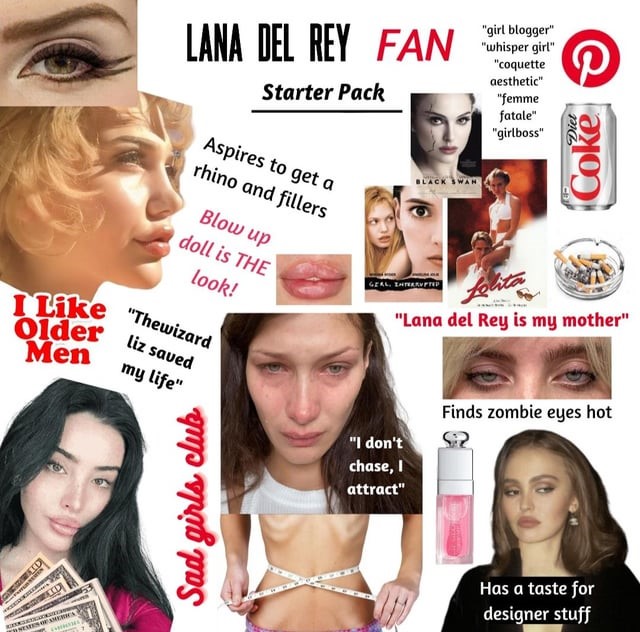
(Meme credit: Optimal-Mastodon9499 on Reddit)
Elizabeth “Lizzie” Woolridge Grant was born on the 21st of June 1985, in an upper middle-class household to a Mother with whom she has a difficult relationship and domain developer Robert Grant, whom she adores. Elizabeth’s formative years would lay the foundations for the unique persona she would adopt – which was perhaps a chance for her to escape into a world of her own invention, a concept many young girls identify with. Although she grew up singing in church, Lizzie was drawn to New York’s party scene like a moth to a flame, resulting in her parents sending her to a boarding school to overcome her alcohol addiction aged just fifteen.
While she came to terms with being sent away she found refuge in English teacher Gene Campbell, who pulled the classically inappropriate male English teacher move of introducing her to Vladimir Nabokov’s “Lolita” (information here) as well as the legendary work of gangsta rapper Biggie Smalls, an odd combination, but one that would undoubtedly go on to influence her music. Lana hints through her music that their relationship was inappropriate, although there has never been confirmation of this. In a 2014 interview she claimed she was still good friends with him.
Part two, the first album.
After refusing an offer to go to SUNY Geneseo, she moved to Long Island to waitress, where her uncle taught her to play guitar. Shortly after, she started popping up on the New York night-life music scene under a range of different aliases such as “Sparkle Jump Rope Queen” and “May Jailer” before finally settling on “Lana Del Rey”, a combination of actress Lana Turner and Californian town Marina Del Rey, for her first studio album “Lana Del Ray aka Lizzie Grant” which went onto be moderately successful.
The album incorporated early traces of themes that would be prevalent in “Born To Die”, including the discussions of drug/alcohol abuse and Lana’s desire for an older man. Here are some lines from the controversial “Put Me In A Movie”, the album’s most popular song…
“Lights, camera, action
He didn’t know he’d have this much fun
Come on, you know you like little girls
Come on, you know you like little girls”
And here’s this somehow even more controversial lyric from “Smarty”…
“Beat me and tell me no one will love me
Better than you do”
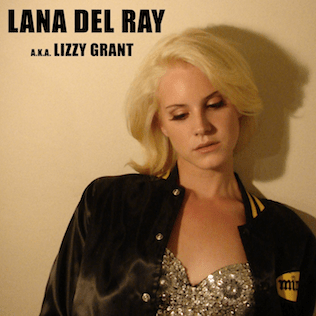
Eventually, Lana had this album wiped from the internet in preparation to ditch her short bleach blonde bob and sundresses for the brunette bombshell curls and Jessica Rabbit ballgowns she would come to be known for after the release of ‘Video Games’ and of course the rest is history. It would be leaked online following her commercial success. While these snippets are a long way off the level of artistry Lana has since proven herself capable of, they are some of the ones frequented by young fans. I’ve seen lyrics such as and similar to these printed on graphic T-shirts and stitched onto lingerie on Depop under the coquette hashtag which have become as synonymous with her brand as spangly gloves with Micheal Jackson or ginger hair with Ed Sheeran. This is not the first time that the music industry has found the taboo of abusive relationships or age gaps playing into success, after all, anything branded as controversial is going to attract a curious audience, and I’m sure that many women have found themselves identifying with Lana’s music, but why in the age of the internet has this found itself associated with it’s own style? A style that has found itself emerging into a lifestyle with its own hobbies, literature and approach to relationships?
The definition of a coquette is a flirtatious young girl, typically one who plays with men’s lust by being seemingly innocent – yet a vixen underneath. This, in the mind of Lana’s fans, is empowering. The fantasy of a “coquette”, after all, is one made up by men. It pretends to unshackle teen girls from the male gaze by repositioning them as in control of the narrative, while it in reality maintains the idea that young girls “leer” older men in, that it is not their fault they cannot control themselves. There is not power in becoming a vessel for a man’s fantasies. Lana’s fanbase can wrap it in a baby pink bow however many times they’d like, but it does not detract from the fact that the romanticisation and trendy-fication of this is not only dangerous, but disrespectful to the real victims of this kind of abuse.
In 1994, a fourteen-year-old Aaliyah Haughton would release her debut album, “Age Ain’t Nothing but a Number”. On the cover, Aaliyah is seen in the forefront repping her signature shades and baggy clothes, however in fuzzy background a much older man leans against a wall, leering at her from afar. This man is no other than Robert “R” Kelly, the “King of RnB” and as of more recent, king of convicted child sex offences. He produced the genre defining album, and less than three months later illegally married his protégé when Aaliyah was just 15 – he thought she was pregnant with his child. This is not very coquette aesthetic. It is also not very empowering.
“Age ain’t nothing but a number
Throwing down ain’t nothing but a thing
This something I have for you it’ll never change”
“All you gotta do is knock, I’ll let you in
And we will feel the passion that flows within.”
-Lyrics from Aaliyah’s, “Age Ain’t Nothing but a Number”, from the album “Age Ain’t Nothing but a Number”, 1994.
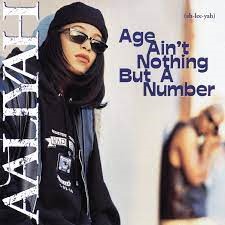
-14 year old Aaliyah and 27 year old R.Kelly on the cover of “Age Ain’t Nothing but a Number” in 1994.
These lyrics (penned by Kelly) alongside the album cover, reposition Aaliyah as the one in control of the situation. When he knocks, SHE lets HIM in. She is in the foreground of the cover to be gazed at by the public just as Kelly does. We know now that there is no possible way Aaliyah was in control or was old enough to be aware of the consequences abuse from a man who was not only her senior in age but also in her industry. While Aaliyah was never able to tell her story after her life was tragically cut short in 2001, this stark contrast between her music and personal life furthers proves that the positioning of young girls as the victors in these scenarios is harmful and wrong.
R.Kelly wrote these lyrics not only to play on a controversy but also to normalise these absurd circumstances through the art of his victim. Except the difference is Lana is a woman who has experienced this abuse herself, and the writer of her own lyrics. Let’s talk about the personal growth that Lana has exhibited since her days as Lizzie Grant.
Part four:
“I don’t like it. I don’t. I don’t sing it. I sing ‘Ultraviolence’, but I don’t sing that line anymore. Having someone be aggressive in a relationship was the only relationship I knew. I’m not going to say that that [lyric] was 100 per cent true, but I do feel comfortable saying what I was used to was a difficult, tumultuous relationship, and it wasn’t because of me. It didn’t come from my end.”
-Lana Del Rey for Pitchfork, 2017, on a lyric from her 2014 album ‘Ultraviolence’.
The lyric that Lana is referring to is “Jim raised me up, he hit me, and it felt like a kiss”, a lyrical reference to the Carole King song that was created about a babysitter’s abusive relationship, referenced in the song ‘Ultraviolence’, about a cult leader who charms young women into following him.
Listening to Lana’s full discography in chronological order is amazing – you hear Lana turn from girl to woman. This growth from “coquette queen” to introspective wordsmith not only displays her personal development but also one that her loyal fans have experienced alongside her. She has gone from asking a man “If I got a little prettier could I be your baby?” on BTD to on her 2019 album Norman Fucking Rockwell admitting the fact that “I used to shoot up my veins in neon / And shit’s even brighter you’re gone”. Not only is Lana’s persona addressing her reliance on drugs, but her reliance on a man.
Lana’s growth not only as an artist but also as a person has been culturally significant – NFR is career defining and critically acclaimed – exhibiting her as a master of her craft. On further albums she reminisces on being “Down at the Men in Music Business Conference” as an unknown waitress and discussing how “I can’t help but feel somewhat like my body marred my soul”.
While Lana has progressed to womanhood, what about her fans who are still trapped in girlhood? Why do they latch on to Lana’s days of sugar daddies and snorting drugs so much? As someone who has spent six years of my life being a teenage girl (although no longer on TikTok) I feel I have a good idea of why.
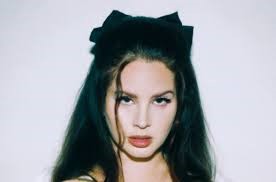
As teen girls, especially younger ones, we love to play with the idea of womanhood. It’s like fancy dress, something we’re not ready for but will try out as if it were a costume: we can take it off at the end of the school formal and return to playing The Sims or doing our homework. What are some of the most appealing aspects of womanhood? Being able to make risky decisions without your parent’s strict guidance and being sexually appealing to older men. There is no shame in wanting to do either of these things, risk taking is something teenagers have done since the dawn of time, and because of the seven billion hormones running through their bodies combined with the fact their brains are faster develop than their male peers, teen girls are bound to be attracted to older people in some capacity. It is only when these desires are tinkered with and taken advantage of that it becomes dangerous.
Lana’s early music speaks directly to both these aspects of womanhood, so no wonder so many adoring adolescents are drawn to it. I was really singing the song “Yayo” aged 14 with not a singular clue what that word meant.
But of course, the internet gives new voice to these girls. They say the most inappropriate things without concept of consequence, spilling private sexual thoughts out loud and even turning on each other when they feel one does not fit into the “coquette” category. They have even shamed Lana herself, only using photos of her from her “BTD” era where she was thinner and more ‘glamourous’, shaming her current figure and her cute-comfy sense of dress. Lana was never purely about looks despite (still) having some akin to a 50’s movie star.
“Will you still love me when I shine from words but not from beauty?”
-Lana Del Rey, “Old Money” from the album “Ultraviolence”, 2014
Here are just some of the absurdly humorous, unnerving, and hopefully ironic things that have been posted by these unhinged Coquette girls:
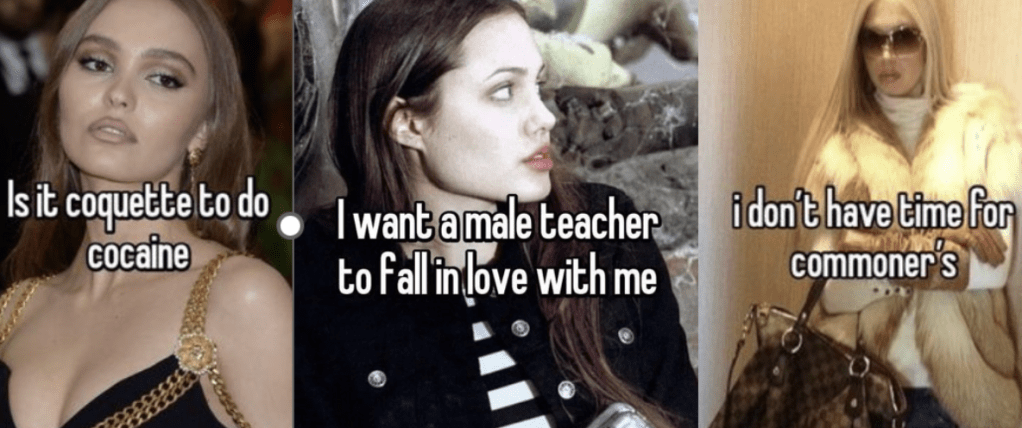
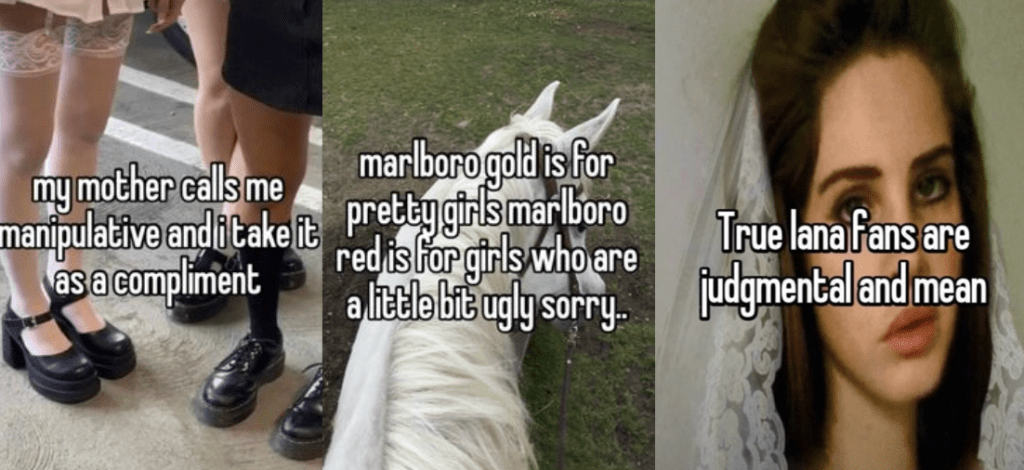
It’s no secret that that women are pitted against each other. It worries me that these young girls are not finding confidence internally by being self-sufficient but are instead looking for outside trends on the internet in order to feel superior to those who don’t participate. It makes me beg the question who is really benefitting from this? Obviously not the girls themselves, but the men who will take advantage of their naivety, and the brands that will flog them anything associated with the trend over TikTok shop. Part of the problem is that from the age of childhood women are taught to simply not question the culture they grow up in. “Question for the culture” is what Lana named a highly controversial 2020 Instagram post where she posed a question to the music industry and feminism movement about how they have treated her music in the past.
“Now that Doja Cat, Ariana, Camila, Cardi B, Kehlani and Nicki Minaj and Beyoncé have had number ones with songs about being sexy, wearing no clothes, fucking, cheating etc – can I please go back to singing about being embodied, feeling beautiful by being in love even if the relationship is not perfect, or dancing for money – or whatever I want – without being crucified or saying I’m glamorizing abuse??????”
-Lana Del Rey, ‘Question For The Culture’, 2020.
As you can see, she compares her brand of womanhood to others’, and I certainly see how this comes off as snooty or superior. I do believe that a lot of 21st century feminism has been about excavating natural softness and behaviours from women to have them act like men. It’s a shoddy attempt to “even the playing field”. This is why we see so many female pop stars talk about sex in a way that mimics the male sexual experience. I think this has had damaging consequences and that it benefits the wrong person, but I also believe in a woman’s right to choose to behave however they want. Of course, it is not the responsibility of Lana Del Rey or any other female pop star to act in a way that constantly upholds feminist values, but I disagree with her further statement that there is not a place in feminism for a woman who looks and acts like her. Frankly, there is. At the end of the day, it is a choice to be feminist, and lets also consider all the different types of women who feminism actually doesn’t extend its hand to.
This being said, feminism hasn’t had the greatest track record with including women who are traditionally feminine. They are often belittled by those who believe they set women back. It’s yet another form of internalised misogyny. This is why you see so many little girls hating anything pink and girly while growing up. Perhaps the coquette movement came about to directly combat this narrative, but somewhere along the line lost its messaging. The question of whether this is the movement’s idol Lana Del Rey’s fault alone begs the further question of where artist’s responsibility for perception of their art lies. I think that Lana’s positive impact on young women, such as introducing them to the classic literature (for example Paradise Lost and A Clockwork Orange) is overlooked in favour of debates around this topic.
I can’t help but wonder what the future holds in terms of the internet’s constant need to snowball every passing fashion trend into having its own personality traits. In a world where young minds are not taught to rationalise and question who truly benefits from what is placed in front of them, is the pastel pink coquette look just another notch on the ladder for a much darker future?
 The Snob Blog
Leave a comment